

Understanding Internal Rhythm and Why It Matters
Defining Internal Rhythm
I remember the exact moment I truly understood internal rhythm. I was watching a master jazz guitarist perform, and even when the backing band made mistakes, he never lost his place.
That’s when it hit me – internal rhythm isn’t just about counting, it’s about feeling time in your bones. And developing internal rhythm was going to be one of the most important things I could focus on to improve my own playing. After many years of playing and teaching, I’ve learned that this is the foundation everything else builds upon.
The Science Behind Musical Timing
Did you know that studies have shown musicians with strong internal rhythm actually have more developed gray matter in certain areas of their brain? It’s fascinating stuff! This isn’t just about talent – it’s about training your brain to become a human metronome.
Impact on Your Playing
Let me tell you about a young student named Brian. He could shred like nobody’s business, but he couldn’t keep time if his life depended on it. Once we focused on developing his internal rhythm, everything changed. His playing became more musical, more professional, and most importantly, more enjoyable for both him and his listeners. It’s safe to say that his work on developing his internal timing changed his playing forever and transformed his career.
Getting Started: Essential Prerequisites
Required Tools
You don’t need fancy equipment to develop great timing! I started with just a $10 metronome and my trusty acoustic guitar. Here’s what you’ll need:
- A basic metronome
- A quiet practice space
- A timer for tracking practice sessions
- A simple notebook for progress tracking
Creating the Right Environment
Trust me on this – your practice space matters more than you think! I learned this lesson the hard way when I tried practicing in my noisy living room for months. Find a quiet spot where you can really focus on the rhythm without distractions.
Mental Preparation
Here’s something they don’t tell you in most guitar books: your mindset is just as important as your practice routine. You need to approach this like learning a new language – it takes time, patience, and consistent practice. You have to commit to it and see it through. That’s where mindset comes in.
The 7 Core Exercises Overview
Progressive Learning Path
I’ve structured these exercises based on years of teaching experience. Each one builds on the previous, creating a solid foundation for your rhythm development. You won’t believe how much progress you can make in just a few weeks of focused practice!
Time Investment
Look, I won’t sugar-coat it – developing solid internal rhythm takes time. But here’s the good news: you don’t need hours every day. I’ve found that 10-20 minutes of focused practice is worth more than 2 hours of unfocused noodling.
Success Indicators
You’ll know you’re making progress when you start catching yourself automatically tapping your foot to music, or when you can feel when something’s slightly off-time. These are the little victories that add up to major improvements!
Exercise 1: Counting and Body Movement
Basic Counting
This might seem too simple, but I promise it’s crucial! Set your metronome to 90 bpm and start by just sitting still and counting “1-2-3-4” out loud, in sync with the metronome. No guitar yet!
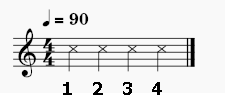
I had a friend who wanted to skip this step – three months later, he admitted this basic exercise was exactly what he needed.
Adding Body Movement
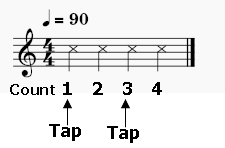
Once you’re comfortable with counting, start tapping your foot on beats 1 and 3. Then add hand movements (such as claps or finger-clicks) on 2 and 4. If you’re struggling with coordination, this can transform your playing in weeks! Ask me how I know!
Common Pitfalls
The biggest mistake I see? Rushing through this foundational step. Take your time here. When I first learned this, I spent two whole weeks just on counting and body movement. It felt like forever, but it paid off tremendously in the long run.
Exercise 2: Subdividing Without Playing
Understanding Basic Subdivisions
Let me share a breakthrough moment I had with subdivisions. I was struggling to teach a student about eighth notes until I had them say “1-and-2-and-3-and-4-and” while walking. His eyes lit up immediately!
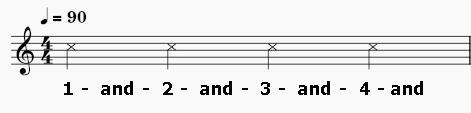
Start by counting quarter notes, then divide each beat into two parts. It’s like slicing a pizza – first in half, then in quarters.
You’ll need to start at a slower BPM number in order to feel comfortable walking at eighth note speed — probably around 60bpm
Mental Counting Techniques
Here’s a trick I learned from a jazz drummer: use different syllables for different subdivisions. I use ‘ta’ for quarter notes, ‘ta-ka’ for eighth notes, and ‘ta-ka-di-mi’ for sixteenth notes. It comes from an Indian method for working on time.
Or, as I do, you can use the whole phrase ‘ta-ka-di-mi’ for four quarter notes, then say it twice as fast for eighth notes and twice as fast again for sixteenth notes. Here’s a diagram showing this with quarter notes and eighth notes. Just double again for sixteenth notes.
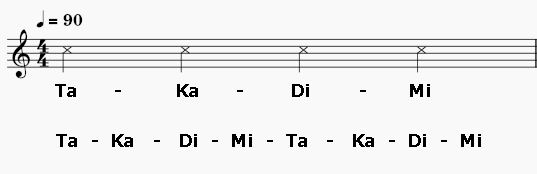
It might sound silly, but it worked wonders for me. There’s something about the rhythm of the syllables that helps you ‘get’ the rhythm of the music, and also makes it easier to switch from quarter notes to eighth notes. I’ve seen it work wonders for others, too! In my experience, students who use this method pick up complex rhythms twice as fast.
Building Complexity
Start simple – just tap your foot on the quarter notes while counting eighth notes out loud. Once that feels natural (it can take up to a week), try counting sixteenth notes.
The traditional method is to count: “1-e-and-a-2-e-and-a,etc.” But, as above, I prefer “ta-ka-di-mi, ta-ka-di-mi, etc”. No guitar yet – trust the process!
Exercise 3: Basic Strumming Patterns
Starting With Quarter Notes
Finally, we’re picking up the guitar! But here’s the catch — we’re keeping it super simple. Just strum down on each quarter note while counting out loud. Sometimes people who can play complex solos struggle with this basic exercise. It’s humbling but you’ve gotta be able to do it!
So this is the same as the first exercise, but now you’re counting and playing along with the metronome. The secret to all this is to add complexity very gradually, and make sure you are solid on the preceding step before moving forward.
Introducing Eighth Notes
Once you’ve mastered quarter notes (and I mean really mastered them), we’ll add upstrokes for the “and” counts. Here’s my favorite practice pattern: strum down on the beats, up on the “ands,” using just one chord. The metronome is still on 1-2-3-4. I practiced this every day, to get the firm foundation of time and rhythm that I so desperately needed.

Adding Syncopation
Remember that jazz drummer I mentioned? He taught me to start by accenting different eighth notes to create simple syncopated patterns. Start by accenting beat 2 and the “and” of 3. It feels weird at first, but stick with it – the groove will come!
Exercise 4: Metronome Drop-outs
The Basic Setup
This is where things get interesting! Some metronomes allow you to mute the metronome for a period of time. So you might set it to click for a bar, then drop out for a bar, then come back in again.
If you don’t have a metronome with this functionality, you can always record the metronome clicking steadily for a couple of minutes, then edit the audio to mute the sound.
However you achieve it start by setting your metronome to quarter notes at 60 BPM. Play along with the click for a bar then, when the metronome drops out, continue to play and keep time on your own for the next bar. When the metronome comes back in, you’ll know if you’ve kept good time. I still remember my first attempt – I was an awful long way off!
As always, record yourself doing this exercise, to hear any errors very clearly.
When you’ve got good at keeping time on your own for one bar, do the same exercise, with the metronome clicking for two bars and then dropping out for two bars. Then four bars.
If you can get to this level and keep good time on your own, your playing will be at a whole new level!
An interesting little story, I once read an interview with one of the well-known old time session players, can’t remember his name now.
Anyway, he described how when he was driving, and the car entered a tunnel, he would lose signal on the car radio until he came out the other end of the tunnel.
You guessed it, he would tap his hand on the dashboard, trying to keep time while in the tunnel! Pretty much the same principle as we have just been going through, but at a pretty extreme level.
Progressive Challenge Levels
We already touched on this above. Once you can stay in time for one bar, try two bars, then four bars, etc. It’s up to you how far you take it.
One thing’s for sure, if you get to 4 bars and beyond, recording yourself all the way, you’ll know for sure how good your timing really is!
I’ve created a progress chart for my students that I’ll share with you in a moment. The key is, as always, to increase difficulty gradually.
Self-Assessment Tools
This is simple, and there’s only one answer. We already said that the best way to assess your current ability and progress is to record yourself doing this exercise.
Many people have discovered that while they thought they were keeping good time, the recordings told a different story! Use your phone’s voice memo app — it’s free and incredibly valuable for feedback.
Exercise 5: Recording and Self-Analysis
Setting Up for Recording
You don’t need fancy equipment at first — some people use their phone for years! Set it up about three feet away from your guitar. The important thing is consistency in your recording setup.
Eventually, you’ll probably want a decent quality recording device. Recording yourself for assessment and improvement doesn’t stop with exercises on your own — you can gain great benefit from recording gigs and rehearsals, too. This is where a better recording device comes into its own.
What to Listen For
First, listen for obvious timing issues – are you rushing or dragging? Then, pay attention to the consistency of your strumming pattern. Finally, check if your accents are even. I have my students create a simple checklist for this analysis process.
Making Adjustments
When you spot issues (and you will — we all do!), don’t get discouraged. Instead, slow down the metronome and focus on the problem area. I once spent an entire week at 50 BPM working on a simple strumming pattern. The improvement was worth every minute!
Exercise 6: Playing with Backing Tracks
Selecting the Right Tracks
Don’t just grab any backing track! Start with simple tracks at moderate tempos (90-100 BPM). I learned this lesson the hard way after frustrating myself with complex jazz tracks too early. My go-to starter tracks are simple blues progressions – they’re perfect for developing groove without overwhelming your brain.
Progressive Challenges
Once you’re comfortable with basic tracks, try this: Play along with tracks that have different feels – straight eighths, shuffle, sixteenth-note grooves. I keep a playlist of backing tracks organized by difficulty. Started doing this after noticing how much faster my students progressed with organized practice materials!
Exercise 7: Advanced Rhythm Integration
Combining Multiple Elements
Now we’re cooking! Try counting out loud while playing syncopated patterns. I remember struggling with this until I broke it down into tiny chunks. Start with a two-bar pattern, master it, then expand. My students who follow this approach consistently show better results.
Genre-Specific Applications
Each style of music has its own rhythmic language. In rock, it’s all about solid quarter notes. In funk, it’s the sixteenth-note subdivisions. Jazz? Triplets are your best friend. I spent years working on different genres, and each one taught me something unique about rhythm.
Mastery Challenges
Here’s my favorite advanced exercise: Try playing a simple pattern while tapping a different rhythm with your foot. Sounds impossible at first, but give it time! I couldn’t do it for months, then suddenly it clicked. These moments of breakthrough are what make practice worthwhile.
Creating Your Practice Routine
Structuring Your Sessions
I’ve found the sweet spot is 30-minute practice sessions. Here’s how I break it down:
- 5 minutes: Warm-up with silent counting
- 10 minutes: Basic rhythm exercises
- 10 minutes: Working on new patterns
- 5 minutes: Recording and analysis
Progress Tracking Methods
Keep a practice journal! I’ve been doing this for years, and it’s invaluable. Write down:
- What you practiced
- Tempo achieved
- Challenges faced
- Small wins (they add up!)
Adaptation Strategies
Remember, this isn’t a one-size-fits-all approach. If something’s not working, modify it! If you struggle with counting out loud, while you’re paying, simplify what you’re playing, until you can count along with it.
If necessary, go right back to playing one guitar note on each quarter note. Once you’re comfortable with that, gradually increase the complexity of what you’re playing, until you’re comfortable counting out loud with that.
Eventually you must get to the point where you can count out loud along with anything you can play…There is no subsitute for this, or way around it. If you find this difficult at first – join the club. But you must get there.
Take comfort from the fact that thousands have been there before you. And, it’s not like this is some elite-level skill you have to be born with. Sure, some find it easier than others – just like everything in life. But anyone can develop this skill with a bit of work.
It’s not that you will spend the rest of your life counting out loud. It’s the fact that developing the independence that allows you to do this will allow you to keep silent track later on. The counting out loud allows you to develop a feel for the passing time grid, over time.
If you can’t play and count aloud, you will never develop this essential skill of keeping track silently. That’s how important this is!
Common Challenges and Solutions
Identifying Problem Areas
Listen to your recordings carefully. Most common issues I see:
- Rushing during fills
- Dragging on slower tempos
- Uneven strumming patterns I’ve developed specific exercises for each of these problems.
Troubleshooting Methods
When you hit a wall (and you will), try this approach:
- Slow it down – way down
- Break it into smaller chunks
- Practice without the guitar first
- Record and analyze This method hasn’t failed me in 15 years of teaching!
Next Steps and Advanced Concepts
Future Development
Once you’ve mastered these exercises, explore:
- Polyrhythms
- Odd time signatures
- Complex syncopation But remember – only after you’ve truly mastered the basics!
Continuing Education
Join a band, take some lessons, play with other musicians. I still learn new rhythmic concepts from my students! The journey never really ends – that’s what makes it exciting.
Conclusion:
Don’t expect overnight success with this broad and deep undertaking. Your journey might take weeks or months, but stick with it. The satisfaction of having solid internal rhythm is worth every minute of practice.
Don’t forget – rhythm is the heartbeat of music. Without it, even the most beautiful melodies fall flat. Start with these exercises today, be patient with yourself, and watch your playing transform.
Now get practicing – your internal metronome won’t develop itself! 🎸